Authors: Franciane Cedrola, Marcus Vinicius Xavier Senra, Millke Jasmine Arminini Morales, Priscila Fregulia, Lucas Canesin, Roberto Júnio Pedroso Dias, Vera Nisaka Solferini
Youg Reviewer: Vedant
Abstract
The capybara, the world’s largest rodent, weighs up to 90 kg and measures over one meter in length. Capybaras feed on grasses, fruits, and tree bark. However, these plants are coated in tough cellulose, which is difficult to digest. To overcome this, the capybara relies on microbes in its gut that help break down the cellulose and release nutrients. One key microbe is Muni, a giant protozoan that can grow to be up to 3 mm long, visible to the naked eye. Scientists have discovered that Muni has genes that produce powerful enzymes essential for the capybara’s digestion. This remarkable partnership between the capybara and its microbial allies highlights how cooperation can help overcome life’s toughest challenges.
The Capybara’s Digestive Challenge
In this article, we will tell a story about the capybara. The capybara is the largest rodent in the world. It lives only in South America, weighs up to 90 kg, measures more than 1 m in length, and survives on a diet consisting solely of plant material, such as grasses, fruits, and tree bark (Figure 1) [1]. But the capybara faces a significant challenge in its life: the plant materials it consumes are tough to digest, because they have a strong shield made of cellulose [2]. But the capybara is not concerned about this, because it has an amazing solution—it teams up with some very tiny “friends” that live in its gut [3, 4]. Who are these friends?
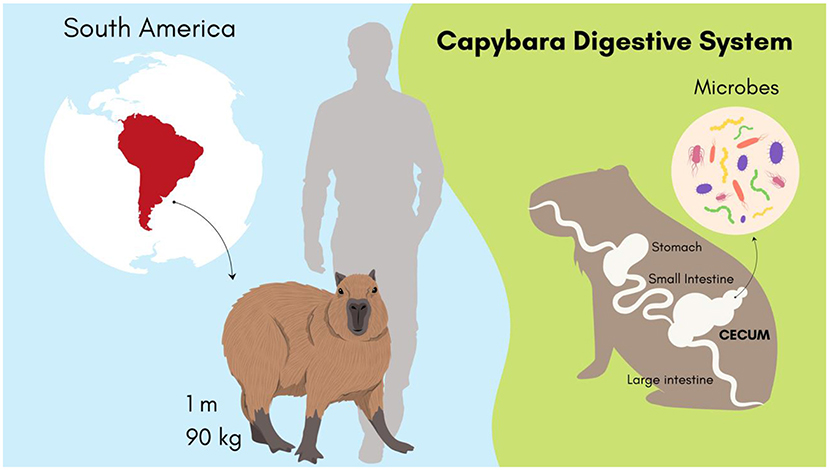
They host several types of microbes inside their guts, particularly in a pouch-like part called the cecum, which help them break down the tough plant materials that they eat.
The Capybara’s Tiny Friends
The tiny friends living in the capybara’s gut are called microbes, and they are good at helping the capybara break down that tough plant shield. Imagine them as little helpers with tools that can chop up the cellulose and unlock all the energy inside the plants [3, 4]. When the capybara eats grass, fruits, or tree barks, the food travels down into its gut, where the microbes get to work. They use their tools, called enzymes, to turn the hard-to-digest food into something that the capybara can use for energy. The resulting products, which may include sugar, proteins, fats, or vitamins, ensure the capybara is satisfied, providing the energy it needs for its activities. But how does this happen?
The Cecum: the Microbe’s Workshop
The secret lies in a special part of the capybara’s digestive system, called the cecum
(Figure 1) [1, 3, 4]. The cecum is a large, pouch-like part of the gut where the microbes—the capybara’s tiny friends—carry out their important work. Inside this pouch, these microbes break down the plant materials and turn them into simple, easy-to-digest pieces. This is how the capybara gets the most out of its food [3, 4].
A Diverse Team of Microbes
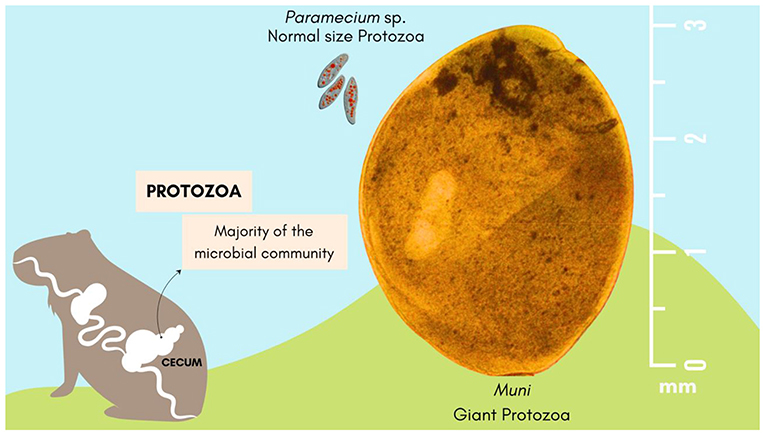
Inside the capybara’s gut, there is a diverse community of microbes [3–5], each with a specific role to play. Some of them are bacteria, which are good at breaking down the tough parts of the plants. There are also fungi, that help by making important nutrients. But some of the most crucial members of this microbial team are the protozoa [4, 5]! Protozoa are single-celled organisms, which means they are just one tiny cell—but they perform a big job [4, 5]. There are approximately 1,000,000 protozoa cells per milliliter of cecum content [5]. Considering that the total volume of the cecum is approximately 2 L, or 2,000 ml, there are billions of these microbes in the capybara’s digestive system. They help break down the plants even more and make sure the capybara gets all the nutrients it needs [4].
The Giant Protozoa, Muni
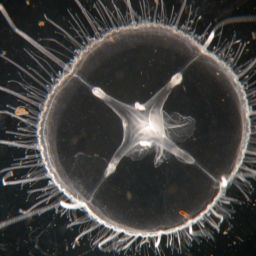
One of the most important protozoa in the capybara’s gut is a giant among microbes, named Muni (Figure 2) [4, 5]. Instead of measuring around 0.3 mm, like many other protozoa, it can measure up to 3 mm [5]! It is so big that it can be seen with the naked eye. This protozoan can break down tough plant material and thus it is indispensable for the capybara [4].
Cecotrophs: Super Nutritious Snacks
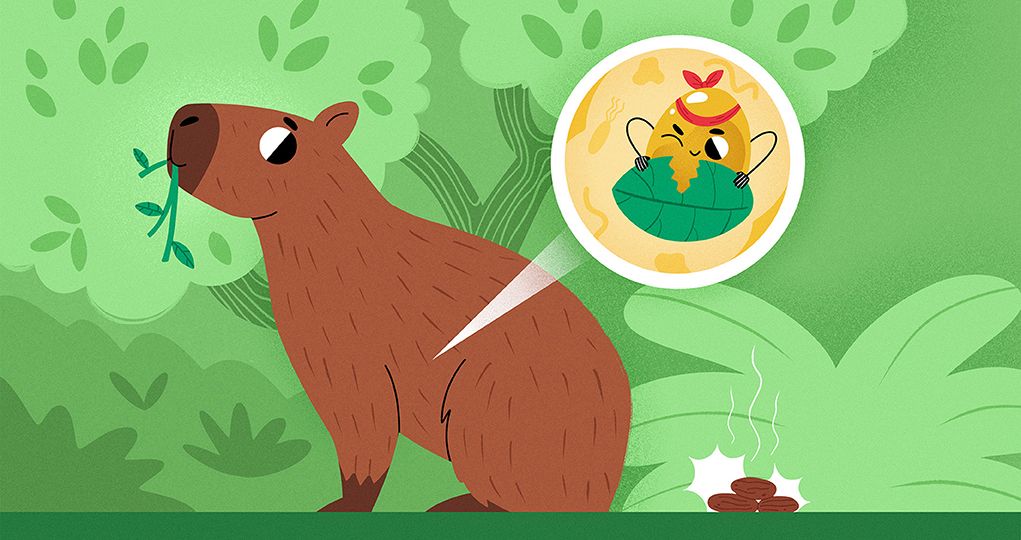
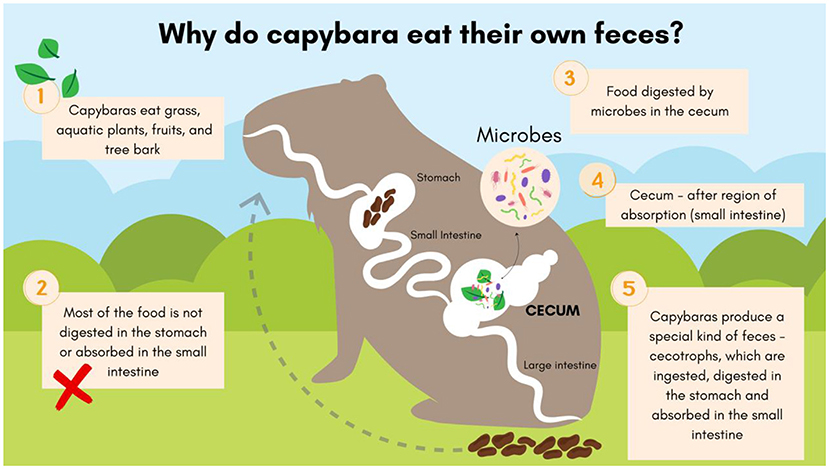
Here is the most interesting part of all: the capybara’s feeding does not stop after the microbes have done their job. In fact, there is a problem: by the time microbes break down the plant material in the large intestine, the food has already passed through the main region where food is absorbed—the small intestine. This means that most of the nutrients released by the microbes would normally be lost. To overcome this, the microbes help the capybara produce a special kind of feces (poop) called cecotrophs [1]. Cecotrophs are like super nutritious snacks that the capybara eats immediately after they are excreted [1]. While this might sound a bit unappetizing, it is a brilliant strategy! By consuming cecotrophs, the capybara ensures that it absorbs every bit of nutrition from its food [1, 3, 4]. Without eating cecotrophs, even with the help microbes, the capybara would not be able to fully benefit from the nutrients in its diet (Figure 3).
A Giant Collaboration for Survival
Interestingly, the relationship between the capybara and Muni is a giants’ cooperation! The capybara is the largest rodent, and Muni is a giant among protozoa. Together, they form an extraordinary team that ensures the capybara thrives on its tough, plant-based diet. This giant collaboration is a remarkable example of how different organisms can work together to overcome challenges and survive in their environments.
Glossary
Cellulose: A complex carbohydrate that forms plant cell walls. It provides rigidity, strength, and is the most abundant organic compound on Earth.
Enzymes: Proteins that speed up chemical reactions in living organisms without being used up. Enzymes play a key role in many body processes.
Digestive System: A series of organs that break down food, absorb nutrients, and change them into substances the body uses for energy, growth, and maintenance.
Cecum: A pouch-like structure at the junction of the small and large intestine, where breakdown of indigestible carbohydrates, like cellulose, occurs, especially in plant eaters.
Bacteria: Single-celled organisms that lack a true nucleus and membrane-bound organelles.
Fungi: Organisms that obtain nutrients by absorbing them from their environment, usually through decomposing organic matter. Fungi cells have nuclei, and they include molds, yeasts, and mushrooms.
Protozoa: A diverse group of microorganisms that do not fit into the categories of plants, animals, or fungi.
Cecotrophs: Soft, mucous-covered feces produced by some mammals, often re-ingested to so that the animal can absorb more nutrients—unlike the hard feces that contains only waste.
Original Source Article
Cedrola, F., Senra, M. V. X., Gürelli, G., Morales, M. J. A., Dias, R. J. P., Soares, W. V. B., et al. 2025. Functional genomics analyses of symbiotic ciliates of herbivorous mammals suggests microbial niche partitioning and more efficiency in rumen environment. Biol. J. Linn. Soc. 145:blaf063. doi: 10.1093/biolinnean/blaf063
References
[1] Moreira, J. R., Ferraz, K. A. P. M. B., Herrera, E. A., and Macdonald, D. W. (eds.). 2013. Capybara: Biology, Use and Conservation of an Exceptional Neotropical Species. New York, NY: Springer.
[2] Bhardwaj, N., Kumar, B., Agrawal, K., and Verma, P. 2021. Current perspective on production and applications of microbial cellulases: a review. Bioresour. Bioprocess. 8:95. doi: 10.1186/s40643-021-00447-6
[3] Cabral, L., Persinoti, G. F., Paixão, D. A. A., Martins, M. P., Morais, M. A. B., Chinaglia, M., et al. 2022. Gut microbiome of the largest living rodent harbors unprecedented enzymatic systems to degrade plant polysaccharides. Nat. Commun. 13:629. doi: 10.1038/s41467-022-28310-y
[4] Cedrola, F., Senra, M. V. X., Morales, M. J. A., Fregulia, P., Canesin, L., Dias, R. J. P., et al. 2024. Giants’ cooperation: a draft genome of the giant ciliate Muniziella cunhai suggests its ecological role in the capybara’s digestive metabolism. Microb. Genom. 10:001263. doi: 10.1099/mgen.0.001263
[5] Cedrola, F., Fregulia, P., D’Agosto, M., and Dias, R. J. P. 2018. Intestinal ciliates of Brazilian Capybara (Hydrochoerus hydrochaeris L.) Acta Protozool. 57:61–7. doi: 10.4467/16890027AP.18.006.8400
Originally published at: Cedrola F, Senra MVX, Morales MJA, Fregulia P, Canesin L, Dias RJP and Solferini VN (2026) The Big Team-Up: How a Giant Microbe Helps the Capybara’s Digestion. Front. Young Minds. 14:1483371. doi: 10.3389/frym.2026.1483371